
The Backlog Graveyard Problem Every team starts with good intentions: 'We'll keep the backlog clean and prioritized!
No Friction to Add Anyone can add anything. Ideas get dumped in.
No commitment to ever do them. 2.
No Pressure to Remove Deleting feels permanent. 'What if we need it later?' Items accumulate forever.
3. No Refinement Process Items added raw.
Never revisited. Never specified.
No Visible Priority Everything looks equal. No clear 'next'.
Priority lives in someone's head. 5.
No Ready Criteria What makes something ready for sprint? No definition.
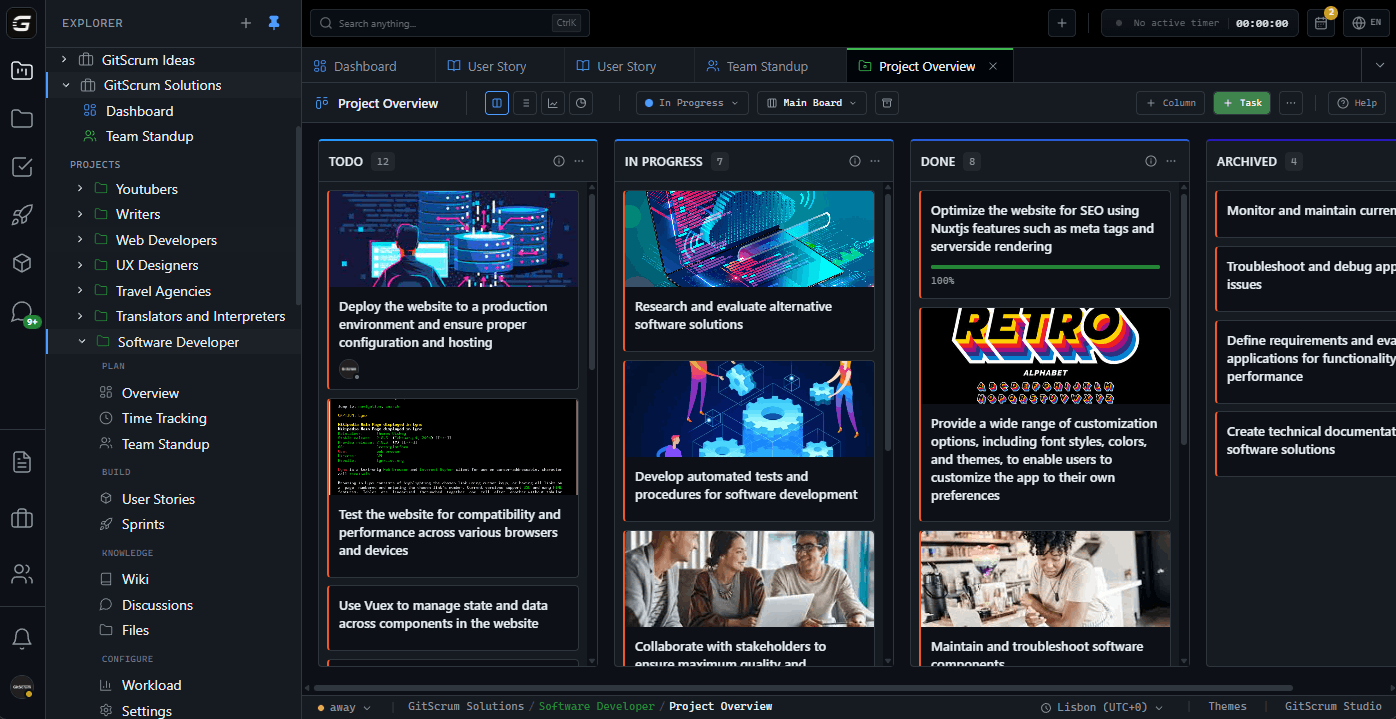
Discovered during planning. What Good Backlog Management Looks Like A healthy backlog: - 30-50 items max - Clearly ordered - Top items fully specified - Top items estimated - Top items marked ready - Bottom items can be rough - Regular grooming removes stale items GitScrum: Backlog That Works Priority Ordering ┌─────────────────────────────────────────────────────────┐ │ Product Backlog Items: 47 │ ├─────────────────────────────────────────────────────────┤ │ Priority Title Points Status │ ├─────────────────────────────────────────────────────────┤ │ ⋮⋮ 1 User Authentication 5 ✓ Ready │ │ ⋮⋮ 2 Payment Integration 8 ✓ Ready │ │ ⋮⋮ 3 Dashboard Analytics 5 ✓ Ready │ │ ⋮⋮ 4 Email Notifications 3 ✓ Ready │ │ ⋮⋮ 5 User Profile Settings 3 ✓ Ready │ │────────────────────────────────────────────────────────│ │ ⋮⋮ 6 Admin Panel 13 Refined │ │ ⋮⋮ 7 Mobile App MVP 20 Rough │ │ ⋮⋮ 8 API Rate Limiting 5 Rough │ │ ...
│ │ ⋮⋮ 47 Legacy Migration ? Icebox │ └─────────────────────────────────────────────────────────┘ ⋮⋮ = Drag to reorder Drag-and-drop ordering: - Visual priority is the order - Top items = next sprint candidates - Bottom items = lower priority - No complex priority fields needed Story Point Estimation Every backlog item can have: - Story points (Fibonacci: 1,2,3,5,8,13,21) - Or T-shirt sizes (XS,S,M,L,XL) - Or custom scale Estimation helps: - Sprint planning capacity - Velocity tracking - Release planning - Effort conversations Unestimated items highlighted: - Easy to find what needs estimation - Refinement sessions focus on these Ready Indicators Definition of Ready (configurable): ☐ User story written ☐ Acceptance criteria defined ☐ Story points estimated ☐ Dependencies identified ☐ Technical approach discussed When all checked: Item marked ✓ Ready In backlog view: - Ready items at top - Ready badge visible - Sprint planning pulls from Ready items Refinement Tracking Backlog refinement states: Icebox → Rough → Refined → Ready Icebox: - Ideas, not committed - Low detail - Review periodically - Delete if stale Rough: - Accepted as real work - Needs refinement - Basic description - No estimate yet Refined: - Full description - Acceptance criteria - Has estimate - Dependencies known Ready: - Definition of Ready met - Can go in sprint immediately - No questions remain Backlog Views List View: - Simple ordered list - Quick scanning - Bulk actions Board View: - Columns by state - Visual refinement flow - Drag between states Filtered Views: - Unestimated items - By epic/theme - By label/tag - By assignee - Stale items (no activity 30+ days) Backlog Grooming Features Quick Add: - Add items from anywhere - Minimal required fields - Details can come later Bulk Actions: - Select multiple items - Move to icebox - Archive - Delete - Add labels - Change estimate Stale Item Detection: - Items untouched for X days - Highlighted in view - Bulk archive old items Icebox Management: - Separate from active backlog - Review periodically - Promote or delete - Keeps main backlog clean Epics and Themes Group related items: Epic: User Management - User Registration - User Login - Password Reset - Profile Settings - User Roles Epic progress: - See completion across items - Story points rolled up - Epic burndown optional Backlog item links: - Parent epic - Blocked by - Related to - Duplicate of User Story Format Template support: As a [user type] I want [goal] So that [reason] GitScrum provides: - Story template - Acceptance criteria section - Technical notes section - Attachments - Discussion thread Example: As a registered user I want to reset my password So that I can regain access if I forget it Acceptance Criteria: ☐ User clicks 'Forgot password' link ☐ System sends reset email within 1 minute ☐ Reset link expires after 24 hours ☐ User can set new password ☐ User receives confirmation email Split Large Items Items too big?
(13+ points) Split feature: 1. Select large item 2.
Click 'Split' 3. Create child items 4.
Original becomes parent/epic 5. Children are estimable Before: 'User Management' (40 pts) After: - Registration (5 pts) - Login (3 pts) - Password Reset (3 pts) - Profile (5 pts) - Roles (8 pts) Smaller = More predictable.
Backlog Metrics Backlog Health: - Total items count - Ready items count - Estimated vs unestimated - Average item age - Stale item percentage Refinement Velocity: - Items refined per week - Time from rough to ready - Bottleneck identification Sprint Readiness: - Ready points available - Sprints of work ready - Refinement needed indicator Backlog and Sprint Planning From backlog to sprint: 1. Filter to Ready items 2.
See velocity capacity 3. Drag items to sprint 4.
Capacity meter updates 5. Commit when satisfied Planning is fast because: - Items are ready - Estimates exist - Priority is clear - No surprises Good backlog = Fast planning.
Multiple Backlogs For larger organizations: - Product Backlog (main) - Technical Debt Backlog - Bug Backlog - Ideas Backlog Or by team: - Team Alpha Backlog - Team Beta Backlog - Shared Backlog Roadmap Integration Backlog items can link to: - Roadmap milestones - Release targets - Quarterly goals See backlog through roadmap lens: - What's needed for Q1 release? - Which items support goal X?
Client/Stakeholder View Client portal shows: - High-priority items - Their requests - Progress on their features Stakeholders can: - View backlog (read-only) - Comment on items - Request priority changes Transparency without chaos. Vs Jira Backlog Jira: ✓ Full backlog management ✓ Epic hierarchy ✗ Complex interface ✗ Many clicks to see details ✗ Priority is a field, not order ✗ Expensive ($17.50+/user) GitScrum: ✓ Full backlog management ✓ Epic hierarchy ✓ Simple interface ✓ Quick inline editing ✓ Priority IS the order ✓ $8.90/user ✓ 2 users free Vs Trello for Backlog Trello: ✓ Simple board ✓ Drag and drop ✗ No native story points ✗ No ready indicators ✗ No refinement states ✗ No velocity tracking ✗ Requires Power-Ups GitScrum: ✓ Simple interface ✓ Drag and drop ✓ Story points native ✓ Ready indicators ✓ Refinement states ✓ Velocity tracking ✓ Git integration Vs Notion for Backlog Notion: ✓ Flexible database ✓ Beautiful docs ✗ Build from scratch ✗ No sprint integration ✗ No velocity ✗ Not PM purpose-built GitScrum: ✓ Purpose-built PM ✓ Ready to use ✓ Sprint integration ✓ Velocity tracking ✓ Git connected Import Existing Backlog From CSV: - Export from current tool - Import to GitScrum - Map fields - Done From Jira: - Export issues - Import with mapping - Preserve estimates - Maintain hierarchy From Trello: - Export board - Import cards - Become backlog items Backlog Management Pricing 2 users: $0/month (free forever) 3 users: $8.90/month 10 users: $71.20/month 25 users: $178/month Includes: - Unlimited backlog items - Story point estimation - Ready indicators - Refinement states - Epics and hierarchy - All backlog features - Sprint integration - Git integration No 'backlog add-on'.
No item limits. Getting Started 1.
Sign up (30 seconds) 2. Create project 3.
Add backlog items 4. Order by priority (drag) 5.
Add estimates 6. Mark ready when refined 7.
Start planning sprints Clean backlog in 30 minutes. $8.90/user/month.
2 users free forever. Backlog management that stays clean.
The GitScrum Advantage
One unified platform to eliminate context switching and recover productive hours.