VS Code

GitScrum for VS Code, Google Antigravity, Cursor and Windsurf!

GitScrum logo
Solution

Clear Project Goals 2026 | Sprint Goals to Daily Tasks

Vague goals like 'improve the product' waste cycles debating success. Structure goals with sprint descriptions, epics, and acceptance criteria—from objectives to daily tasks. Free trial.

Clear Project Goals 2026 | Sprint Goals to Daily Tasks

When project goals are 'make it better' or 'finish by Q4', teams waste cycles debating what success looks like.

GitScrum provides a multi-level goal hierarchy: Sprints have dedicated description fields where you define the sprint goal—what this iteration should achieve. User Story Epics group related requirements under named objectives, showing aggregated progress toward each goal.

Individual user stories carry acceptance criteria that define exactly what 'done' means. This cascading structure connects high-level project goals to daily developer tasks, ensuring everyone from executives to individual contributors knows exactly what they're building toward.

The GitScrum Advantage

One unified platform to eliminate context switching and recover productive hours.

01

problem.identify()

The Problem

Project goals are vague and open to interpretation

No clear connection between high-level objectives and daily tasks

Teams debate what 'done' looks like for the entire project

Progress tracking is subjective without measurable milestones

Sprint planning happens without defined sprint goals

02

solution.implement()

The Solution

Sprint descriptions define specific iteration goals—what this sprint should achieve

User Story Epics group requirements under named objectives with aggregated progress tracking

Acceptance criteria on every user story define exactly what 'done' means

Burndown charts and velocity tracking show measurable progress toward goals

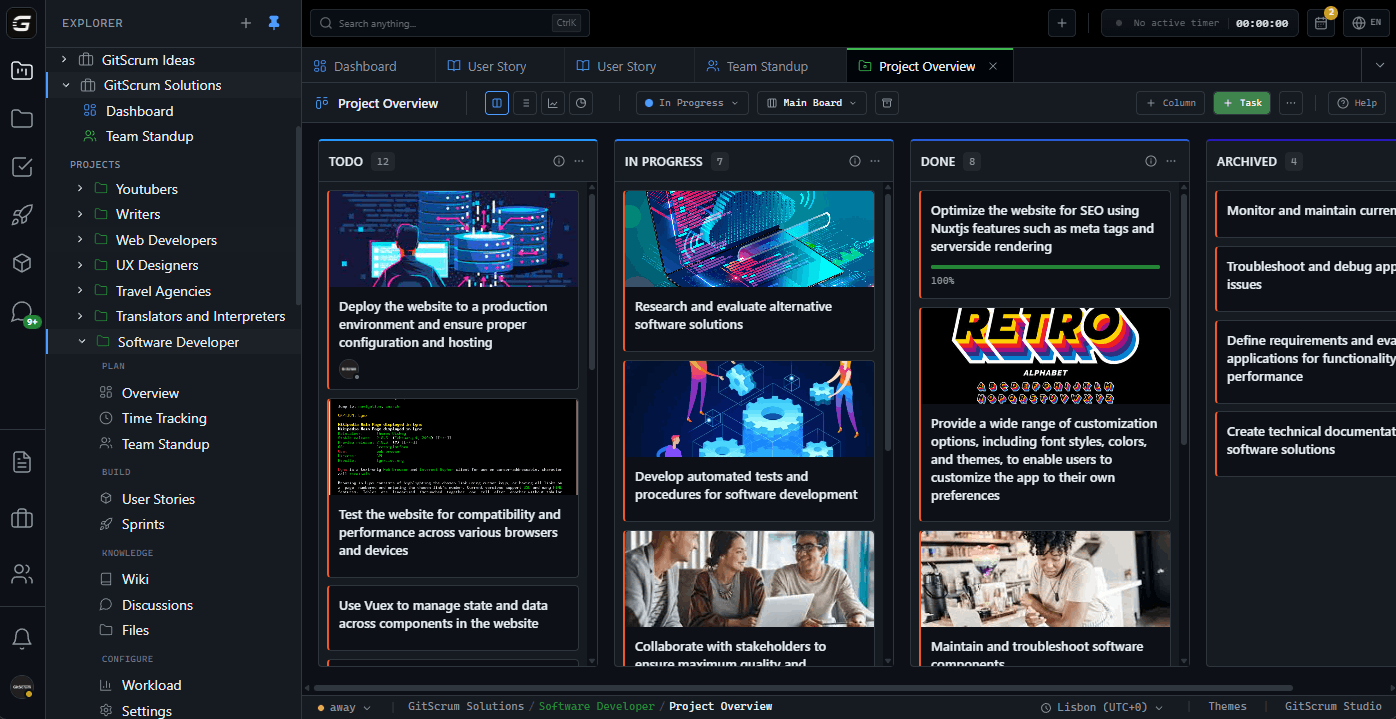
Project overview dashboard shows completion rates across sprints and epics

03

How It Works

1

Define Sprint Goal

When creating a sprint, write a clear description: 'Complete checkout flow redesign' or 'Ship mobile notifications MVP'. This becomes the north star for the iteration.

2

Create Epics

Group related user stories under epics like 'Payment System', 'User Onboarding', or 'Mobile App Launch'. Each epic represents a major project milestone.

3

Write Acceptance Criteria

For each user story within an epic, define testable acceptance criteria. 'User can save credit card' becomes 'Card number validated, last 4 digits displayed, encryption verified'.

4

Track Progress

Sprint burndown shows daily progress toward the sprint goal. Epic progress bars show completion percentage across all related stories.

5

Review & Adjust

At sprint end, review goal achievement. Did we complete the checkout redesign? Epic analytics show what percentage of the larger objective is complete.

04

Why GitScrum

GitScrum addresses How to Define Clear Project Goals for Development Teams through Kanban boards with WIP limits, sprint planning, and workflow visualization

Problem resolution based on Kanban Method (David Anderson) for flow optimization and Scrum Guide (Schwaber and Sutherland) for iterative improvement

Capabilities

  • Kanban boards with WIP limits to prevent overload
  • Sprint planning with burndown charts for predictable delivery
  • Workload views for capacity management
  • Wiki for process documentation
  • Discussions for async collaboration
  • Reports for bottleneck identification

Industry Practices

Kanban MethodScrum FrameworkFlow OptimizationContinuous Improvement

Frequently Asked Questions

Still have questions? Contact us at customer.service@gitscrum.com

How do I write effective sprint goals?

Sprint goals should be specific and achievable within the iteration. Instead of 'work on payments', write 'Ship Stripe checkout integration with saved cards'. The goal should answer: what will be demonstrably different at sprint end? Keep it to one primary objective so the team can focus.

What's the difference between epics and sprints?

Epics are theme-based groupings that may span multiple sprints—like 'Payment System Overhaul'. Sprints are time-boxed iterations (typically 2 weeks) with specific goals. An epic might take 3 sprints to complete, with each sprint tackling different user stories within that epic.

How do acceptance criteria connect to project goals?

Acceptance criteria are the atomic definition of 'done' at the story level. When all stories in an epic have their acceptance criteria met, the epic goal is achieved. When sprint stories meet their criteria, the sprint goal is reached. This creates a traceable chain from project objectives to daily tasks.

How can I see progress toward goals?

GitScrum provides multiple views: sprint burndown shows daily progress toward sprint goals, epic progress bars show percentage completion of larger objectives, and project overview aggregates all sprints and epics to show overall project health. Velocity trends help predict future goal achievement.

What if goals change mid-sprint?

Agile embraces change, but sprint goals should be relatively stable. If priorities shift dramatically, consider ending the sprint early and starting a new one with updated goals. For minor adjustments, update epic names and story acceptance criteria—GitScrum tracks all changes so the team stays aligned.

Ready to solve this?

Start free, no credit card required. Cancel anytime.

Works with your favorite tools

Connect GitScrum with the tools your team already uses. Native integrations with Git providers and communication platforms.

GitHubGitHub
GitLabGitLab
BitbucketBitbucket
SlackSlack
Microsoft TeamsTeams
DiscordDiscord
ZapierZapier
PabblyPabbly

Connect with 3,000+ apps via Zapier & Pabbly