
The PR Black Hole Developer opens PR.
Requests review. Waits.
Day 1: Nothing. Day 2: Ping on Slack.
'Hey, can someone review?' Day 3: Still nothing. 'Is anyone available?' Day 4: Frustration.
'This is blocking me.' Day 5: Manager asks why feature isn't shipped. The PR sat in a black hole.
Nobody's fault. Nobody's priority.
Just lost in the noise. The Notification Disaster Reviewer's GitHub inbox: - 47 unread notifications - 12 PR review requests - 23 comments on various PRs - 8 mentions - 4 CI failure alerts Everything equally urgent.
Nothing stands out. Review requests buried.
The Context Split To understand review status: 1. Check GitHub for PR status 2.
Check project board for task status 3. Check Slack for discussions 4.
Check email for notifications Four places. Four different truths.
Four context switches. The Invisible Queue 'What needs review right now?' Answer: Nobody knows.
- No queue - No priority - No visibility - No accountability Reviews happen when reviewers remember. Or when developers beg.
The Merge But Not Done Problem PR merged. Task still says 'In Progress'.
'Is this done?' 'Let me check GitHub...' Project management and code disconnected. Status lies.
GitScrum: Code Review as Workflow Code review isn't separate from project management. It's part of the workflow.
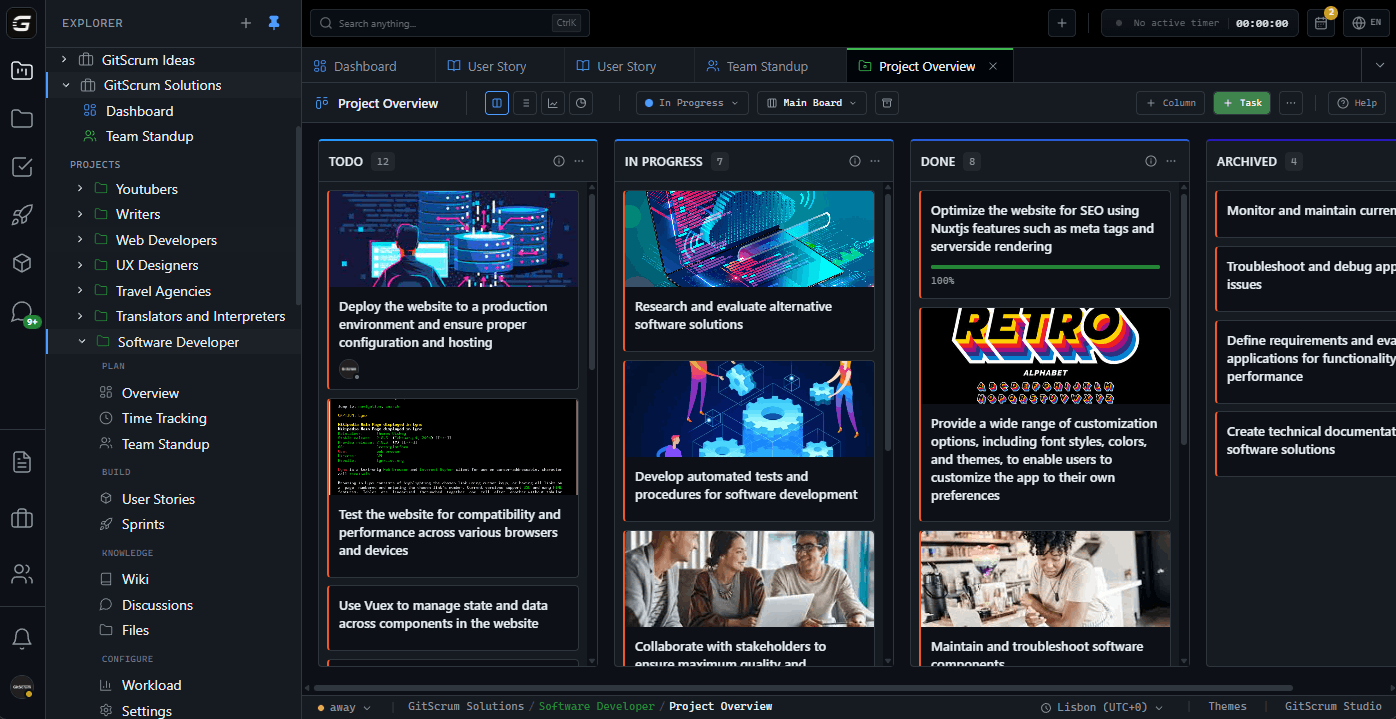
GitScrum makes PRs visible, trackable, and managed. PR-Task Linking Automatic connection: PR 42 referencing Task 123 → Task shows linked PR → PR shows linked task → Both visible from either view No manual linking.
Just reference in PR description or branch name. Review Column on Board Workflow columns: | To Do | In Progress | In Review | Done | 'In Review' column: - Tasks waiting for code review - PR status visible on card - Reviewer assigned visible - Days waiting shown Board IS the review queue.
PR Status on Task Card Each task card shows: - PR linked (yes/no) - PR status (open/approved/changes requested/merged) - CI status (passing/failing) - Reviewer(s) assigned - Days since opened No need to check GitHub. Status on the card.
Review Needed Alerts Configurable alerts: - PR open > 24 hours without review → Alert - PR approved but not merged → Alert - Changes requested but not addressed → Alert Notifications go to: - Assignee (address feedback) - Reviewer (pending reviews) - Team lead (if blocked > threshold) Review Metrics Dashboard Track review health: - Average time to first review - Average time to merge - PRs waiting > 24 hours - Review load per team member Identify bottlenecks. Balance review load.
Improve cycle time. Review Assignment Who should review?
Options: - Manual assignment on task - Round-robin (distribute evenly) - Code owner based (from CODEOWNERS) - Expertise based (tag matching) Clear accountability. No 'someone will review it.' Review SLA Tracking Define expectations: - First review within 4 hours - Changes addressed within 24 hours - Merge within 48 hours of approval SLA violations visible: - Which PRs are past SLA - Which reviewers are bottlenecks - Where process breaks down Status Automation Automatic flow: 1.
Task in 'In Progress' 2. PR opened → Task moves to 'In Review' 3.
Review requested → Reviewer notified 4. Changes requested → Task shows 'Changes Needed' 5.
Approved → Task shows 'Approved' 6. Merged → Task moves to 'Done' Zero manual status updates.
Review Comments on Task Synced comments: - PR comments visible on task - Discussion in one place - Context preserved - No checking multiple platforms Review conversation is part of task history. CI/CD Integration Build status on task: - Tests passing/failing - Build status - Deployment status 'Why isn't this merged?' → 'Tests failing.
See CI details.' Visible without leaving project management. Review Workload Balancing Dashboard shows: - Reviews assigned per person - Reviews completed per person - Average response time Imbalanced?
- Someone has 10 pending reviews - Others have 0 Rebalance. Distribute.
Ship faster. Blocked by Review Filter One-click filter: 'Show all tasks blocked by code review' List of tasks waiting: - Who needs to act - How long waiting - Priority level Daily review meeting in 5 minutes.
Vs. Separate Systems GitHub alone: - PR queue disconnected from project - No priority context - No workflow visibility - Manual status sync Jira + GitHub: - Complex integration to set up - Often breaks - Duplicate information - Still context switching GitScrum: - Native integration - Single view - Automatic sync - Review is workflow The Review Meeting With GitScrum, review standup: 'What's waiting for review?' → Filter: 'In Review' → See all PRs, days waiting, assigned reviewers 'Who's blocked?' → Filter: 'Blocked by review' → Assign reviewers, set priority 5 minutes.
Clear picture. Action items.
Reviewer Notifications Smart notifications: - Review assigned → Notify immediately - Review waiting > 24h → Reminder - High priority task → Urgent indicator - Batch notifications (not per-comment spam) Get notified. But not overwhelmed.
Post-Merge Tracking Merged isn't always done: - Needs deployment - Needs QA verification - Needs documentation update GitScrum tracks post-merge steps: - 'Merged' → 'Deploying' → 'Deployed' → 'Done' True completion, not just merge. The Result With GitScrum code review workflow: - PRs visible in project context - Review queue is the board - Bottlenecks identified - SLAs tracked - Reviewers accountable - Merge faster Code review becomes predictable.
The GitScrum Advantage
One unified platform to eliminate context switching and recover productive hours.