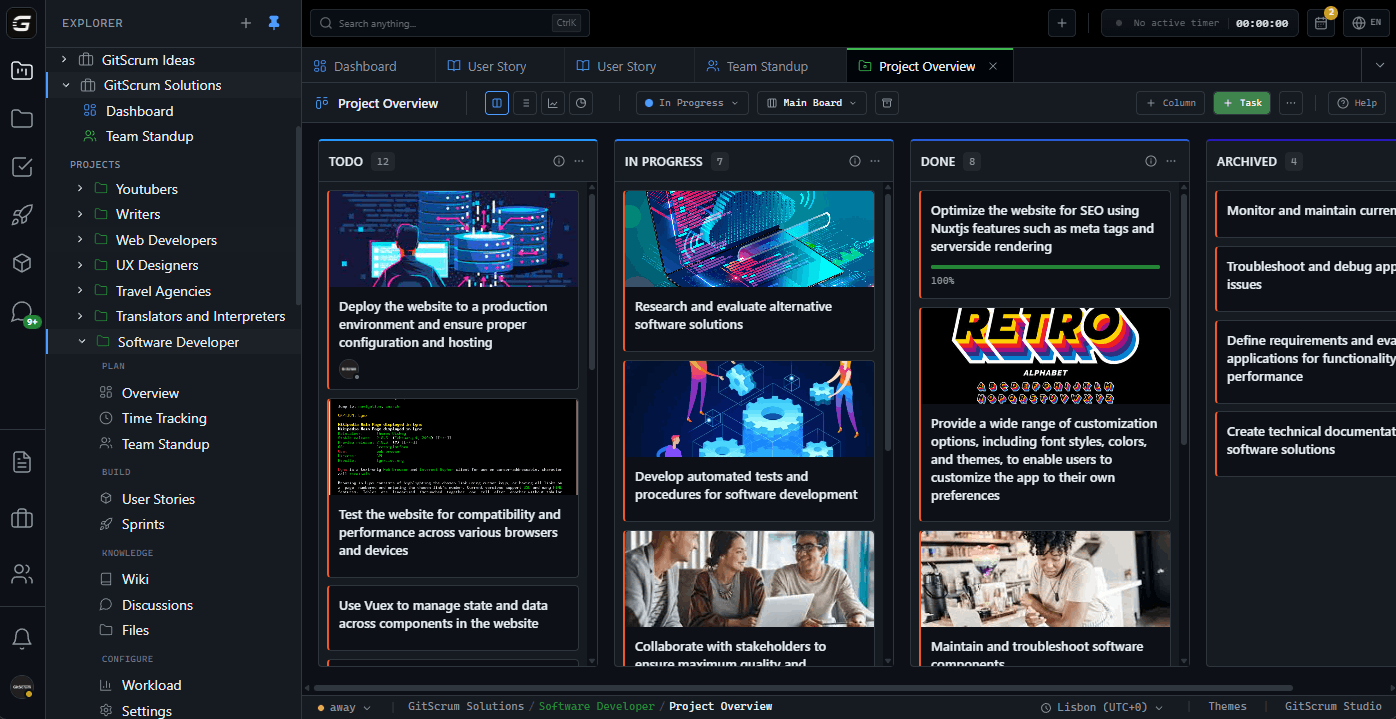
VS Code

GitScrum for VS Code, Google Antigravity, Cursor and Windsurf!

GitScrum logo
Solution

Communication Breakdowns 2026 | Context With Work Items

Decisions buried in Slack, context lost in email. GitScrum: task comments centralize discussions, activity feeds show all changes. Free trial.

Communication Breakdowns 2026 | Context With Work Items

In distributed teams, communication breakdowns are the top velocity killer.

Critical decisions get buried in Slack threads. Context lives in email chains no one can find.

One developer makes a change another wasn't told about. Requirements clarifications happen in a call that wasn't documented.

The result: rework, delays, frustration, and finger-pointing. GitScrum solves this by making the work item the communication hub.

Task comments keep discussions attached to deliverables—searchable forever, visible to anyone who touches that task. Discussion Channels provide persistent project-wide conversations that don't disappear like chat.

mentions ensure the right people are notified without hoping they saw a message. Task activity feeds show who changed what and when.

Notification settings let each person control their interrupt level. Team Standup provides async visibility into what everyone is working on.

The pattern: context travels with work, not in separate communication silos.

The GitScrum Advantage

One unified platform to eliminate context switching and recover productive hours.

01

problem.identify()

The Problem

Critical decisions get buried in chat threads and lost within days

Email chains contain context that new team members can never find

Developers make changes without knowing about related work by others

Requirements clarifications happen verbally and aren't documented

Communication silos mean the same information exists in multiple disconnected places

02

solution.implement()

The Solution

Task comments attach discussions to work items—context travels with deliverables

Discussion Channels provide persistent, searchable project conversations

Task activity feeds show all changes, comments, and status updates in one timeline

mentions ensure specific people are notified of relevant discussions

Team Standup provides async visibility into what everyone is working on

03

How It Works

1

Centralize on Work Items

Make task comments the primary place for work-related discussions. When someone asks about a task in chat, move the conversation to the task itself. Context stays attached to the work—findable by anyone, anytime.

2

Use Discussion Channels for Broader Topics

For discussions that don't belong to a specific task—architecture decisions, team processes, announcements—use Discussion Channels. They're persistent, threaded, searchable. Unlike chat, nothing disappears.

3

Document Verbal Decisions

After calls or meetings, summarize decisions in task comments or discussion channels. 'Per today's call, we decided X because Y.' This creates a searchable record that wasn't there before.

4

Watch Activity Feeds

Task activity feeds show every change: status updates, comment additions, assignee changes, due date modifications. Review activity feeds to understand what's happening on work you care about without asking.

5

Use mentions Strategically

mention teammates when you need their input or want to ensure they see something. They get notified without relying on them to check every channel. Use sparingly—too many mentions create noise.

04

Why GitScrum

GitScrum addresses Preventing Communication Breakdowns in Distributed Software Teams through Kanban boards with WIP limits, sprint planning, and workflow visualization

Problem resolution based on Kanban Method (David Anderson) for flow optimization and Scrum Guide (Schwaber and Sutherland) for iterative improvement

Capabilities

  • Kanban boards with WIP limits to prevent overload
  • Sprint planning with burndown charts for predictable delivery
  • Workload views for capacity management
  • Wiki for process documentation
  • Discussions for async collaboration
  • Reports for bottleneck identification

Industry Practices

Kanban MethodScrum FrameworkFlow OptimizationContinuous Improvement

Frequently Asked Questions

Still have questions? Contact us at customer.service@gitscrum.com

How do I move scattered conversations to GitScrum?

When discussions happen in chat or email, copy key decisions/context to the relevant task as a comment: 'Per Slack discussion on [date], we decided X. Reasons: Y, Z.' Then link to the task when future questions arise. Over time, the team learns to start discussions on tasks instead of chat.

How do activity feeds reduce communication breakdowns?

Activity feeds show every change on a task: status updates, comments, assignee changes, attachments. Instead of asking 'what's happening with this task?', you can see the history. When you pick up a task, the activity feed shows what the previous person did. No information lost in handoffs.

When should I use mentions vs relying on notifications?

Use mentions when you specifically need someone's attention or input—they get an explicit notification. Don't mention for FYI updates that don't require action. Rely on general notifications (task watched, sprint membership) for passive awareness. Over-mentioning creates noise and trains people to ignore mentions.

How do we ensure verbal decisions get documented?

Make it a team norm: after any call with decisions, someone summarizes in writing. 'Per [date] call: decided A, rejected B because C, action item D assigned to E.' Post to the relevant task or discussion channel. Rotate responsibility. Make it fast (5 min) not formal. The habit matters more than perfection.

What about quick questions that don't need documentation?

Chat is fine for ephemeral questions: 'Are you available to pair?' 'What's the API endpoint URL?' But if the answer contains decisions, context, or information someone might need later, it belongs in GitScrum. Ask yourself: 'Will someone else need this in a week?' If yes, document it.

Ready to solve this?

Start free, no credit card required. Cancel anytime.

Works with your favorite tools

Connect GitScrum with the tools your team already uses. Native integrations with Git providers and communication platforms.

GitHubGitHub
GitLabGitLab
BitbucketBitbucket
SlackSlack
Microsoft TeamsTeams
DiscordDiscord
ZapierZapier
PabblyPabbly

Connect with 3,000+ apps via Zapier & Pabbly