VS Code

GitScrum for VS Code, Google Antigravity, Cursor and Windsurf!

GitScrum logo
Solution

Dev Productivity Loss Prevention 2026 | Task Switching Fix

Task switching costs 23 min recovery time. Position-ordered backlogs show next task instantly—no decisions, no context reload. Free trial.

Dev Productivity Loss Prevention 2026 | Task Switching Fix

Developers who jump between unrelated tasks throughout the day never achieve deep work.

Each switch requires mental context loading—remembering where you left off, what the requirements were, which files were involved. GitScrum combats this with clear task prioritization: position-ordered backlogs show exactly what to work on next.

Sprints limit work-in-progress to what's actually achievable. Time tracking reveals which tasks consume the most focus.

Labels let developers batch similar work—do all 'bug fix' tasks together, then switch to 'features'. The result: fewer switches, deeper focus, more output.

The GitScrum Advantage

One unified platform to eliminate context switching and recover productive hours.

01

problem.identify()

The Problem

Developers switch between unrelated tasks dozens of times daily

No clear priority order means constant decision-making about what to do next

Work-in-progress sprawls across too many half-finished tasks

Similar tasks (bugs, features, reviews) get scattered throughout the day

Time spent on task switching is invisible and unmeasured

02

solution.implement()

The Solution

Position-ordered backlogs show clear priority—work top to bottom

Sprint commitment limits work-in-progress to achievable scope

Labels let developers filter and batch similar task types together

Time tracking reveals actual time distribution across task categories

Personal 'My Tasks' view shows only what you're assigned to work on

03

How It Works

1

Order Your Backlog

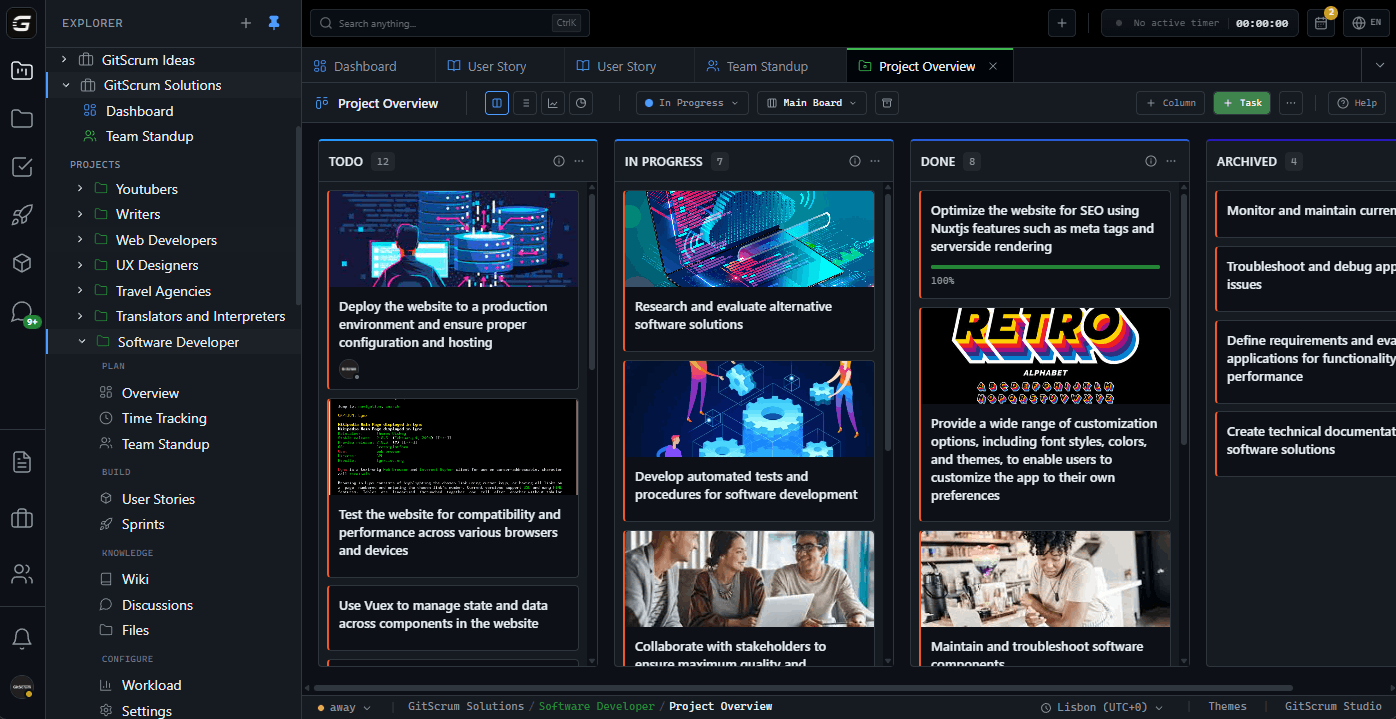
Use drag-and-drop to position tasks by priority. The highest-priority task is always at the top. When you finish one task, the next one is obvious.

2

Commit to Sprint

Pull only as many story points as your team can actually deliver. Sprint capacity shows when you're overcommitting. Finish what you start.

3

Batch by Label

Filter tasks by label: show all 'bugs' and fix them in sequence. Then filter 'features' and build them together. Batch processing reduces context switches.

4

Track Time

Start the timer when you begin a task. Time tracking reveals patterns: are bugs taking longer than estimated? Is review time exploding? Data drives improvement.

5

Focus with My Tasks

The 'My Tasks' view filters to only your assignments. No noise from other team members' work. See your personal queue clearly and work through it sequentially.

04

Why GitScrum

GitScrum addresses Preventing Developer Productivity Loss from Task Switching through Kanban boards with WIP limits, sprint planning, and workflow visualization

Problem resolution based on Kanban Method (David Anderson) for flow optimization and Scrum Guide (Schwaber and Sutherland) for iterative improvement

Capabilities

  • Kanban boards with WIP limits to prevent overload
  • Sprint planning with burndown charts for predictable delivery
  • Workload views for capacity management
  • Wiki for process documentation
  • Discussions for async collaboration
  • Reports for bottleneck identification

Industry Practices

Kanban MethodScrum FrameworkFlow OptimizationContinuous Improvement

Frequently Asked Questions

Still have questions? Contact us at customer.service@gitscrum.com

How does backlog ordering help productivity?

When your backlog is position-ordered, you never have to decide what to work on next—it's always the top task. This eliminates decision fatigue and ensures you're always working on what's most important. Drag-and-drop ordering makes it easy to re-prioritize as needs change.

What is work-in-progress limiting?

WIP limiting means committing to finish current tasks before starting new ones. Instead of having 10 tasks 'in progress', you work on 2-3 until they're done. GitScrum's sprint planning shows your capacity, and you can see if too many tasks are stuck in progress columns on your board.

How do labels help with batching?

Labels categorize tasks by type: 'bug', 'feature', 'research', 'review'. Filter your board or backlog by label to see only similar tasks. Working through all bugs in sequence is more efficient than switching between a bug, a feature, a review, and back to a bug.

What does time tracking reveal about productivity?

Time tracking shows where your hours actually go versus where you think they go. You might discover bugs take 3x longer than features, or that 'quick' tasks actually consume 40% of your day. This data helps you improve estimates, batch efficiently, and identify productivity bottlenecks.

Can I see only my assigned tasks?

Yes. The 'My Tasks' view filters to show only tasks assigned to you across all projects. No noise from teammates' work. You see your personal queue clearly and can work through it without distraction from tasks that aren't your responsibility.

Ready to solve this?

Start free, no credit card required. Cancel anytime.

Works with your favorite tools

Connect GitScrum with the tools your team already uses. Native integrations with Git providers and communication platforms.

GitHubGitHub
GitLabGitLab
BitbucketBitbucket
SlackSlack
Microsoft TeamsTeams
DiscordDiscord
ZapierZapier
PabblyPabbly

Connect with 3,000+ apps via Zapier & Pabbly