VS Code

GitScrum for VS Code, Google Antigravity, Cursor and Windsurf!

GitScrum logo
Solution

Dev Tool Fatigue Solutions 2026 | Add 1, Remove 4

Devs burn out from tools, not code. Each SaaS adds cognitive load—login, switch tabs, sync, update. GitScrum replaces Jira+Confluence+Toggl+reporting with 1 platform. One mental model, sub-100ms UI. Free trial.

Dev Tool Fatigue Solutions 2026 | Add 1, Remove 4

Tool fatigue isn't about any single tool being bad.

It's the accumulation. Each new SaaS requires learning new UI patterns, remembering new credentials, building new muscle memory.

The cognitive load compounds invisibly until developers feel exhausted before writing their first line of code. The Symptoms of Developer Tool Fatigue: Passive Resistance: Developers stop updating tools properly.

They take shortcuts. They use the minimum features.

Not because they're lazy—because every tool interaction drains mental energy they need for actual problem-solving. Context Switching Dread: The sigh before switching from IDE to Jira.

The reluctance to log time. The avoidance of updating task status.

These micro-resistances signal a brain protecting itself from overhead. Process Cynicism: 'Here's another tool that's supposed to help.' Developers become skeptical of any new process improvement because they've been burned by tool promises before.

Information Hunting: Where was that documented? Was it in Notion?

The constant searching across platforms consumes mental bandwidth that should go toward creative work. The Root Cause: Tool fatigue comes from fragmentation.

Each specialized tool solves one problem while creating integration overhead. Jira for PM.

Confluence for docs. Toggl for time.

Separate dashboards. Separate logins.

Separate mental models. Developers need to hold all these contexts simultaneously.

Their working memory—limited by biology—gets occupied by tool logistics instead of code architecture. How GitScrum Reduces Cognitive Load: One Mental Model: GitScrum organizes everything around the concept developers already know: project boards with cards.

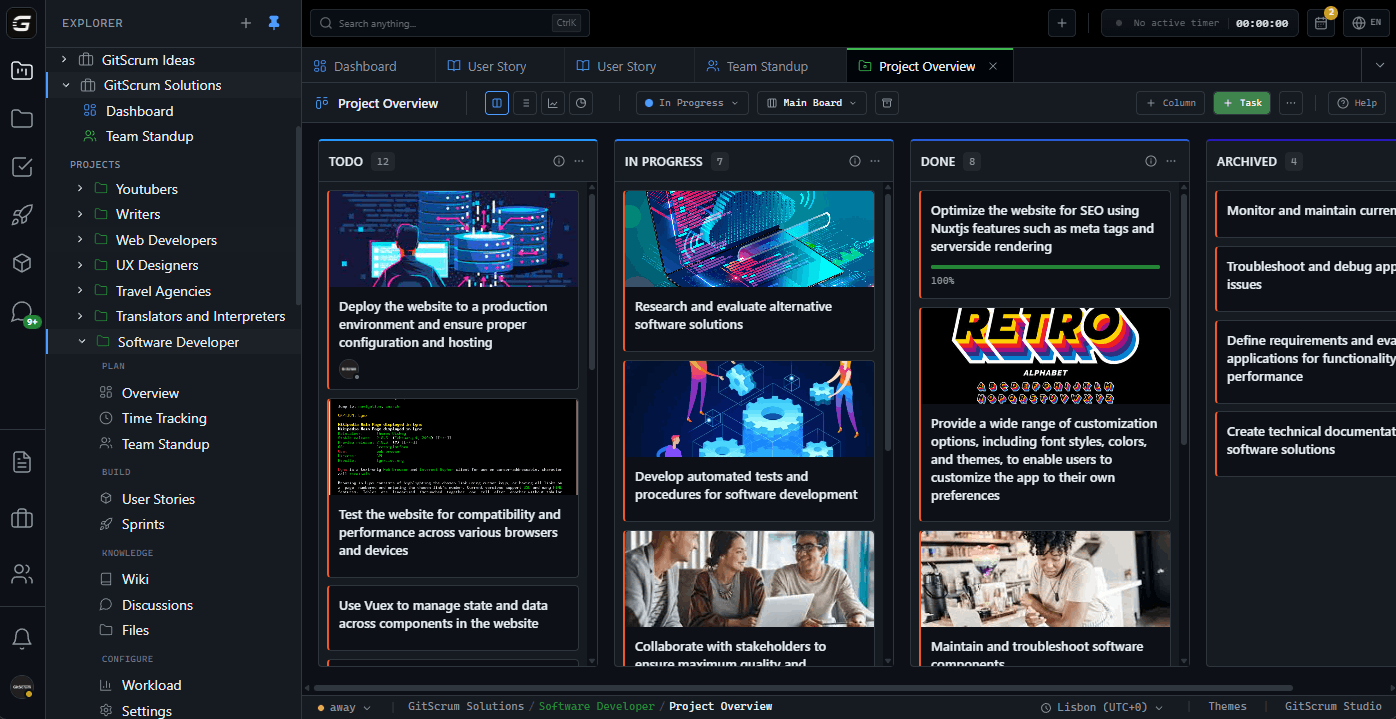
Tasks, time, docs, sprints—all accessible from one unified interface. GitHub-Native Workflow: No context switch between code and PM.

GitScrum integrates deeply with GitHub. PRs link to cards.

Commits update status. The tools developers already use become the data source.

Everything Discoverable: Where's that documentation? In the wiki.

Where's the time log? On the task.

Where's sprint progress? On the board.

One mental map instead of seven. Minimal Feature Bloat: GitScrum includes what developers need—not everything that could theoretically be useful.

Client portals. No feature overwhelm.

Fast UI: Sub-100ms response times. Keyboard shortcuts throughout.

Dark mode. The interface respects developer workflow instead of fighting it.

$8.90/user/month for reduced cognitive load. 2 users free forever to experience the difference first.

The GitScrum Advantage

One unified platform to eliminate context switching and recover productive hours.

01

problem.identify()

The Problem

Each new tool adds cognitive load and requires learning new patterns

Developers feel exhausted before writing their first line of code

Passive resistance to tool updates and process improvements

Context switching dread drains mental energy needed for problem-solving

Information scattered across platforms requires constant hunting

Working memory occupied by tool logistics instead of code architecture

02

solution.implement()

The Solution

One unified platform with familiar board-and-card mental model

GitHub-native workflow eliminates code-to-PM context switches

Everything discoverable in one location—no information hunting

Minimal feature set focused on developer needs—no bloat

Sub-100ms response times with keyboard-first design

Clear pricing at $8.90/user/month reduces decision fatigue too

03

How It Works

1

One Mental Model

Everything in GitScrum organizes around boards and cards. Tasks, sprints, time logs, docs—all accessible from the same mental framework developers already know.

2

GitHub-Native Integration

No context switching between code and project management. PRs link automatically. Commits update cards. Your GitHub becomes the single source of truth.

3

Everything in One Place

Time tracking on tasks. Documentation in wiki. Sprint progress on boards. Client updates in portals. No hunting across platforms. No multiple logins.

4

Respect Developer Workflow

Sub-100ms UI. Keyboard shortcuts. Dark mode. Fast search. The interface adapts to how developers work—not the other way around.

04

Why GitScrum

GitScrum addresses Developer Tool Fatigue Solutions through Kanban boards with WIP limits, sprint planning, and workflow visualization

Problem resolution based on Kanban Method (David Anderson) for flow optimization and Scrum Guide (Schwaber and Sutherland) for iterative improvement

Capabilities

  • Kanban boards with WIP limits to prevent overload
  • Sprint planning with burndown charts for predictable delivery
  • Workload views for capacity management
  • Wiki for process documentation
  • Discussions for async collaboration
  • Reports for bottleneck identification

Industry Practices

Kanban MethodScrum FrameworkFlow OptimizationContinuous Improvement

Frequently Asked Questions

Still have questions? Contact us at customer.service@gitscrum.com

How does GitScrum actually reduce cognitive load?

By consolidating PM tools into one familiar interface. Instead of learning 7 different tools with 7 different mental models, developers learn one. Everything—tasks, time, docs, sprints—follows the same board-and-card pattern they already understand.

Won't adding another tool make fatigue worse?

Not if that tool replaces multiple others. GitScrum consolidates Jira + Confluence + Toggl + client reporting into one platform. You add one tool but remove four. Net cognitive load decreases.

What about developers who love their current tools?

GitScrum integrates with GitHub—the tool developers already love. It enhances their workflow rather than replacing it. The goal is fewer tools overall, not forcing developers away from what works.

How long does it take to see fatigue reduction?

Most teams report reduced frustration within the first week. The elimination of context switching between PM tools is immediately noticeable. Full productivity gains typically emerge within 2-4 weeks.

Ready to solve this?

Start free, no credit card required. Cancel anytime.

Works with your favorite tools

Connect GitScrum with the tools your team already uses. Native integrations with Git providers and communication platforms.

GitHubGitHub
GitLabGitLab
BitbucketBitbucket
SlackSlack
Microsoft TeamsTeams
DiscordDiscord
ZapierZapier
PabblyPabbly

Connect with 3,000+ apps via Zapier & Pabbly