Developers spend an estimated 4-6 hours per week on status reporting—updating Jira tickets, writing slack summaries, filling out progress spreadsheets, preparing for standup updates.
This is administrative overhead that produces no code, ships no features, and fixes no bugs. Worse, it interrupts flow state.
Every time a developer stops coding to update a ticket, they lose 15-23 minutes of productivity recovering their context. The irony is that the information already exists: they're doing the work, the work has status, the status could be tracked automatically.
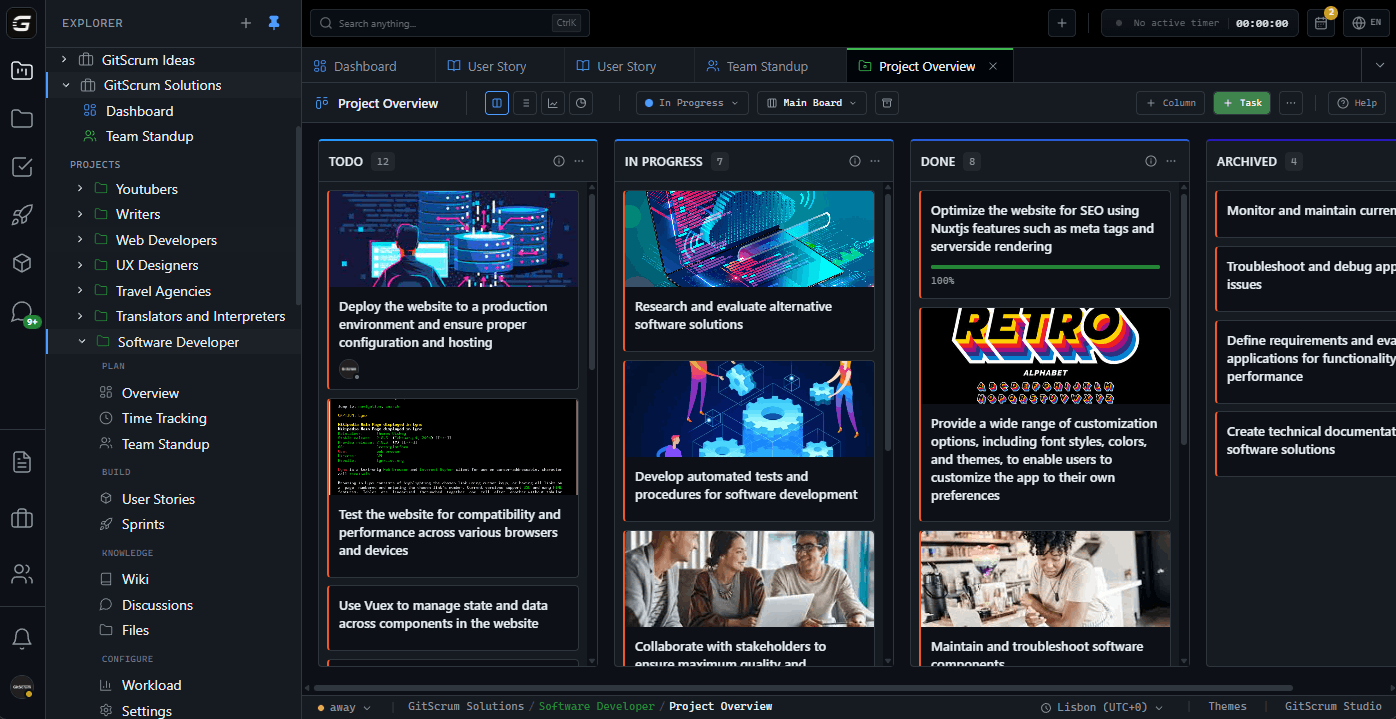
GitScrum eliminates manual status reporting through work-integrated tracking. When developers move tasks on the Kanban board, that movement is the status update—no separate reporting required.
Time tracking captures effort investment as developers work—starting a timer is the activity log. The activity feed shows what changed, when it changed, who changed it—without anyone writing a summary.
Task comments become the documentation trail—no separate status email needed. Webhook integrations sync with GitHub, GitLab, Bitbucket—when code is committed, PRs are opened, or branches are merged, the task updates automatically.
Manager Health dashboards aggregate this automatic data into status views: what's in progress, what's blocked, what's completed. No developer had to write a status report for that visibility to exist.
Sprint dashboards show progress against commitments through task state, not through written updates. The standup dashboard pulls automatic data—Yesterday shows completed tasks, Today shows work in progress, Blockers shows blocked items.
All derived from work activity, not manual reporting.
The GitScrum Advantage
One unified platform to eliminate context switching and recover productive hours.